
A friend recently reached out with a question about design organizations at banks.
They were working with a design team that needed to rationalize its size, structure, reporting model, and leadership levels by looking at examples from other regional banks in the United States.
Hey Van,
I’m working with a design team that is rationalizing its size and structure and needs to point to some examples of teams at other regional banks in the U.S.
- Number of design executives at AVP / Senior Director and above
- Executive levels represented in Design and Research, such as AVP, VP, and SVP
- Highest-level design position title
- Where design reports into, such as Line of Business, Technology, Enterprise Services, Marketing, or Customer Experience
Any unofficial data points you can share from your experience would help greatly.
I was excited to put my experience down on paper and think through what I have seen work, what I have seen struggle, and what conditions help design teams actually function inside large financial institutions.
Rationalizing a design team’s size and structure starts with understanding the problems that team is being asked to solve. That means getting clear on the customer pain points, the technology needed to support the experience, the business opportunity, and the organizational capacity required to deliver a better outcome.
In many organizations I have experienced, hiring happens first. Problems are then pushed toward designers through business leaders, with technology expected to arrive at the end and deliver efficiently. That sequence creates friction. It can also place designers in a reactive role, where they are asked to make sense of unclear priorities after the operating model has already been set.
I advocate for a different starting point: a cross-functional team defining and ranking the problems first, then hiring and organizing the specific skills needed to solve those problems well.
I believe design teams and creative problem solvers produce their best work inside well-defined, psychologically safe, and diverse small-team cultures.
Problem clarity is the first step toward that kind of environment.
In the banks and financial institutions where I have worked, there has almost always been a business leader ultimately accountable for design. A seasoned design leader is usually responsible for guiding the designers, managing the production of work, and helping the team maintain quality across products, services, and customer journeys.
Some of those models have been very successful and psychologically safe. Others have been difficult. The difference often comes down to whether design has enough authority, trust, and organizational access to shape decisions before they become delivery requests.
I know of very few banking organizations where a traditional design craft leader reports directly to the CEO. Chase may be one of the more interesting organizations to watch over the next several years, especially given the conversation with Kaaren Hanson on Finding Our Way.
I also asked ChatGPT how it would answer the original question. The response lined up with what I would consider common industry patterns, and I thought the summary was useful as a broad framing:
To provide accurate and relevant information regarding the structure and size of design teams at regional banks in the U.S., we need to look at several dimensions. Specific numbers and titles vary by institution, but there are common patterns across the industry.
Number of design executives at AVP / Senior Director and above
The number of design executives at AVP, Senior Director, and above varies widely depending on the size and scope of the bank. A large regional bank might have several executives in these roles, while a smaller bank may have fewer.
- 1–3 AVPs or Senior Directors in Design
- 1 VP of Design
- 1 Chief Design Officer, Chief Experience Officer, or senior experience leader if the bank is heavily design-focused
Common executive levels in Design and Research
- Assistant Vice President
- Vice President
- Senior Vice President
- Executive Vice President
- Chief Design Officer or Chief Experience Officer
Highest-level design position title
- Chief Design Officer
- Chief Experience Officer
- Executive Vice President of Design, Experience, or Customer Experience
Common reporting structures for design
- Line of Business, where design is embedded directly into business units
- Technology, where design partners closely with product, engineering, and delivery teams
- Enterprise Services, where a centralized design team serves multiple areas of the organization
- Customer Experience, Marketing, or Strategy, where design is tied to customer-facing transformation and brand expression
See below for a diagram of what I have observed across organizations, along with the model I believe creates the healthiest conditions for committed design teams working inside a business-focused context.
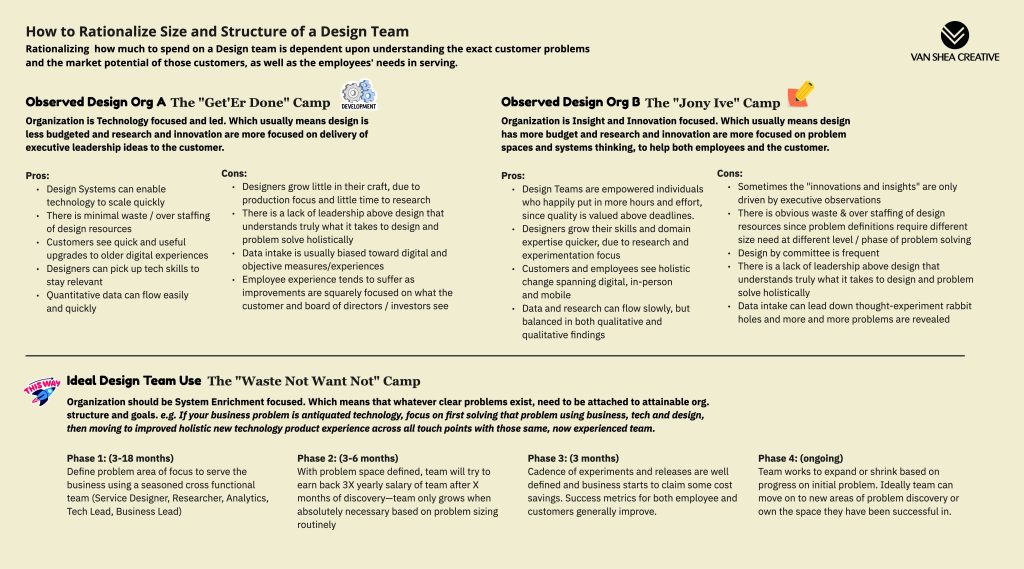
My recommendation, especially for political orientation and creative autonomy, is an enterprise-situated design organization serving technology, marketing, and lines of business through smaller squads. That organization should be led by a senior design executive with enough authority to shape enterprise priorities, influence customer strategy, and protect the quality of the work.
In the strongest version of this model, design reports through a Chief Design Officer, Chief Experience Officer, or comparable enterprise leader with a clear connection to the CEO and executive team.
Would that be the right answer for every bank? Probably not. Design needs a culture it can participate in, influence, and strengthen. The structure only works when the organization is willing to let design shape decisions, clarify problems, and improve the systems that produce customer and employee experiences.
Ultimately, design is only as functional as the organization allows it to be.